
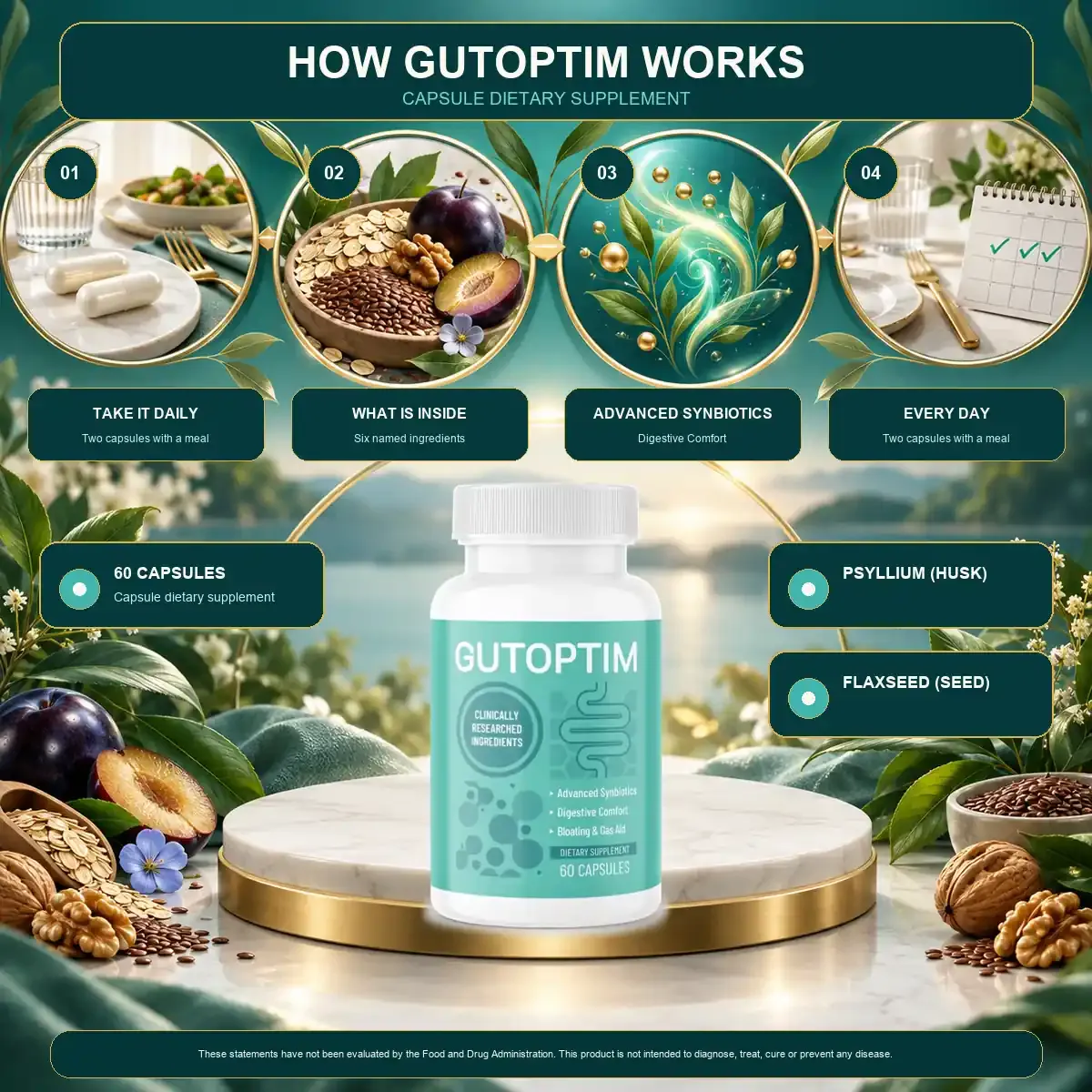
How Does GutOptim Work? The Fiber Gel, Step by Step
Quick answerGutOptim works mainly as a bulk-forming fiber that gives stool soft bulk.
Psyllium, glucomannan, apple pectin, flaxseed and oat bran take on water and form a gel. Bentonite clay binds material in the gut and L. acidophilus adds a probiotic, all in a 1.5 g blend in 2 capsules.
Learn how to take it with enough liquid.
How does GutOptim work, in short?
GutOptim works mostly like a bulk-forming fiber. Its gel fibers soak up water in the gut and turn into a soft, slippery mass. That mass adds bulk to stool and helps it pass more easily.
Around that fiber core sit three other ideas. Some fibers feed gut bacteria. A clay binds material in the gut. And a probiotic adds one named species. The full list is on the GutOptim ingredients page.
What do the gel-forming fibers do?
Five ingredients carry soluble fiber: psyllium, glucomannan, apple pectin, flaxseed and oat bran. When they meet water, they thicken. The result is a gel that holds water all the way through the gut.
This gel does two useful things. When stool is hard, the trapped water softens it. When stool is loose, the gel firms it up. That two-way action is why psyllium is called a stool normalizer (McRorie et al., 2021).
Psyllium keeps its gel longest
Psyllium is described as a gel-forming fiber that gut bacteria barely ferment. So its gel tends to survive into the colon, where it does most of its work. The same review puts the therapeutic dose near 10 g a day.
Glucomannan swells the most
Glucomannan can absorb a large amount of water for its weight. It adds a lot of bulk from a small amount. It is also the reason swelling-fiber products must carry a choking warning (21 CFR 201.319).
Pectin, flaxseed and oat bran add a softer gel
These three thicken less than psyllium but still hold water. Flaxseed brings a sticky coat called mucilage. Oat bran brings beta-glucan, which gives oatmeal its creamy texture.
Why can fiber cause gas at first?
Some fibers are food for gut bacteria. When bacteria ferment them, they make gas and short-chain fatty acids. Apple pectin, oat bran and the plum in GutOptim are all fermentable to some degree.
A clinical guideline notes that fermentable fibers can add gas and bloating, and it favors soluble, gel-forming fiber like psyllium (ACG IBS guideline, 2021). Prunes also raised flatulence in a trial of 80-120 g a day (Lever et al., 2019). For most people, this settles as the gut adjusts.
The post on why fiber can cause bloating at first explains the timing in more detail.
What does the bentonite clay do in the gut?
Bentonite clay is made of thin, layered mineral sheets. It swells in water and carries a surface charge. That charge lets it hold other substances as it moves through the gut.
A related pharmaceutical clay shortened acute diarrhea in children by about a day (Szajewska et al., 2006). That is the best human data for clays in the gut. It does not test clay for bloating in adults.
Binding works both ways
The same binding can grab some medicines and iron. Take them at a different time from GutOptim, and ask a pharmacist how far apart. The how to take GutOptim page has a simple timing plan.
What is the probiotic idea behind “Advanced Synbiotics”?
The word synbiotic means a mix of prebiotic fiber and probiotic bacteria. In GutOptim, the fibers are the prebiotic half and Lactobacillus acidophilus is the probiotic half. The idea is that fiber gives bacteria food while the probiotic adds a helpful species.
To count as a probiotic, microbes must be alive and given in an adequate amount (Hill et al., 2014). About 1 billion CFU per serving is a common minimum in that consensus. Benefits also depend on the exact strain, not just the species name.
What happens after you take GutOptim?
The ingredients follow one path from the first sip of water to the colon. Here is that path in five steps.
Swallow with a meal and water
Two capsules go down with food and a full glass of liquid. The gelatin shell dissolves in the stomach within minutes.
Fibers start to swell
Psyllium, glucomannan and pectin draw in water and begin to thicken into a gel.
The gel moves through the small intestine
Human enzymes cannot break down these fibers, so most of the gel passes through intact.
Clay binds as it travels
Bentonite clay carries a surface charge and can hold other substances as it moves along.
Bacteria meet the fiber in the colon
Fermentable fibers feed resident bacteria. The probiotic joins them, and stool leaves with the gel's added water and bulk.
How long does the fiber effect take to show?
No trial of GutOptim itself has been published, so there is no product timeline to quote. What exists is timing from single-ingredient studies. Those ran from 3 to 12 weeks.
- Days 1-7
The gut meets more fiber and water. Some people notice extra gas as bacteria start to ferment the new fiber.
- Weeks 2-3
The prune vs. psyllium trial measured its results at three weeks. Gas from fermentation often eases in this window.
- Weeks 4-12
Longer fiber trials, like the 12-week flaxseed study, judged results over this span.
Your own pace depends on diet, water and how your gut reacts to fiber. The GutOptim results timeline sets out what to watch for week by week.
Which mechanism goes with which ingredient?
| Mechanism | Ingredients | Evidence type | Source |
|---|---|---|---|
| Bulk and water-holding | Psyllium, glucomannan, apple pectin, flaxseed | Human trials, at 3-10 g a day | (McRorie et al., 2021) |
| Regularity from whole foods | Plum (prunes), flaxseed | Human trials, at 10-120 g a day | (Lever et al., 2019) |
| Fermentation by gut bacteria | Apple pectin, oat bran, plum | Well known; can add gas early | (ACG IBS guideline, 2021) |
| Binding in the gut | Bentonite clay | Child diarrhea data only; not bloating | (Szajewska et al., 2006) |
| Probiotic support | L. acidophilus | Strain-specific; strain not published | (NIH ODS, Probiotics) |
| Traditional use | Black walnut hull, aloe vera leaf | Little or no good human evidence | (WebMD, Black Walnut) |
Where is the evidence strong, and where is it weak?
The fiber mechanism is well supported in human studies. The rest of the formula has thinner evidence. And the finished product has not been tested in a published trial.
Stronger human evidence
- Psyllium is the most studied fiber for regularity and IBS symptoms (Moayyedi et al., 2014).
- Flaxseed at about 10 g a day improved constipation in a 12-week trial (Soltanian & Janghorbani, 2018).
- Prunes at 80-120 g a day raised stool weight and frequency (Lever et al., 2019).
- Gel fibers holding water is basic, well-understood physiology.
Weak or missing evidence
- No trial of the GutOptim formula itself has been published.
- Each fiber is a share of 1.5 g, below the 3-10 g doses studied.
- The probiotic strain and CFU count are not on the label.
- Black walnut hull and oral aloe lack good evidence for gut comfort (NCCIH, Aloe Vera).
Dose matters most here. Ten ingredients share 1.5 g, while single-fiber studies used 3 to 10 g a day. The side-by-side numbers are on the Supplement Facts page.
How does a digestive health supplement fit with food?
Most fiber still comes from food. U.S. adults average about 15-18 g of fiber a day (USDA WWEIA, 2017-2020). The goal for adults is about 22-34 g, and more than 90% of women and 97% of men fall short (Thompson, 2021).
GutOptim is a small daily add-on to that total. Beans, oats, fruit, vegetables and whole grains provide the grams. Water matters too, because gel fibers need liquid to work. Our digestive health guide covers daily habits.
How GutOptim works: FAQ
How does GutOptim work in the body?
Its fibers absorb water and form a gel that adds bulk and softness to stool. Some fibers are fermented by gut bacteria, the clay binds material in the gut, and a probiotic is added on top.
Is GutOptim a laxative?
It is sold as a dietary supplement, not a laxative drug. Its main fibers work the way bulk-forming fibers do, by holding water, rather than by pushing the bowel to contract.
Why might GutOptim cause gas at first?
Fibers such as pectin, oat bran and the fruit in the blend are fermented by gut bacteria, and fermentation makes gas. This often settles as the gut adjusts over a few weeks.
What does the clay in GutOptim do?
Bentonite clay swells and can hold other substances on its surface. That is also why it may bind some medicines and iron, so spacing them apart matters.
Does the probiotic in GutOptim reach the gut?
The label does not publish the strain or CFU count, so survival and dose cannot be checked. Probiotic effects depend on the exact strain and amount.
Why does GutOptim need a full glass of water?
The gel fibers swell as they absorb liquid. Without enough water they can swell in the throat, which is why the label carries a choking notice.
Has GutOptim itself been tested in a clinical trial?
No trial of the finished product has been published. The research on this page is on its single ingredients, usually at larger doses.
Ready to try GutOptim?
Two capsules a day with a meal and a full glass of water. From $49 a bottle with free US shipping and a 60-day money-back guarantee. Questions first? Call +1 (302) 200-3480.