


Why Fiber Can Cause Bloating at First, and How GutOptim Users Can Ease In
Quick answerGut bacteria ferment many fibers and make gas as they do. A sudden jump in fiber gives them more to ferment, so bloating is common at first. Fermented fibers and prunes add the most gas; in one trial, 80-120 g of prunes a day raised flatulence. Go slowly, take GutOptim with a full glass of liquid, and add one new food fiber a week.
Why does more fiber make more gas?
Fiber makes gas because your gut bacteria eat it. Your own enzymes cannot digest most fiber. So it travels to the colon, where bacteria break it down and release gas along the way.
That gas is a normal by-product. The trouble starts when fiber jumps up fast. Your bacteria get a sudden feast, and the gas arrives before your gut has settled into the new pattern.
Fermentation in plain terms
Fermentation is how bacteria turn fiber into energy. They make short-chain fatty acids, which the colon uses, plus gases such as carbon dioxide and hydrogen. More fermentable fiber means more of both.
Why it feels like bloating
Gas takes up room. When it builds faster than it moves on, your belly feels full, tight or noisy. That is the feeling most people call bloating.
Which fibers add the most gas?
Not all fibers ferment the same. Some are eaten quickly by bacteria, and some pass through mostly intact. A major U.S. guideline warns that fermented fibers can add gas and bloating (ACG IBS guideline, 2021).
| Fiber or food | In GutOptim? | How much bacteria ferment it | Early gas potential |
|---|---|---|---|
| Psyllium husk | Yes | Very little (McRorie et al., 2021) | Lower |
| Glucomannan (konjac) | Yes | Fermented | Moderate |
| Apple pectin | Yes | Fermented | Moderate |
| Oat bran | Yes | Fermented (beta-glucan) | Moderate |
| Flaxseed | Yes | Partly fermented | Moderate |
| Plum (prunes) | Yes | Fiber plus sorbitol (Lever et al., 2019) | Higher |
| Wheat bran | No | Mostly insoluble; did not help IBS in trials (Moayyedi et al., 2014) | Varies |
| Beans and lentils | No | Fermented | Higher at first |
For a full look at each fiber, read psyllium vs. other fibers.
Is early bloating a sign something is wrong?
Mild bloating in the first days is usually a sign your gut is adjusting, not that something is wrong. Your bacteria are responding to new food. Many people find it fades as their routine settles.
Prunes show the trade-off clearly. In one trial, 80 to 120 g of prunes a day raised stool weight and frequency. It also raised flatulence (Lever et al., 2019). The same food that helped regularity added gas.
What matters is the trend. Gas that eases over days is normal. Pain that grows, or symptoms from the red-flag list further down, is a reason to call a doctor.
Start GutOptim the gentle way
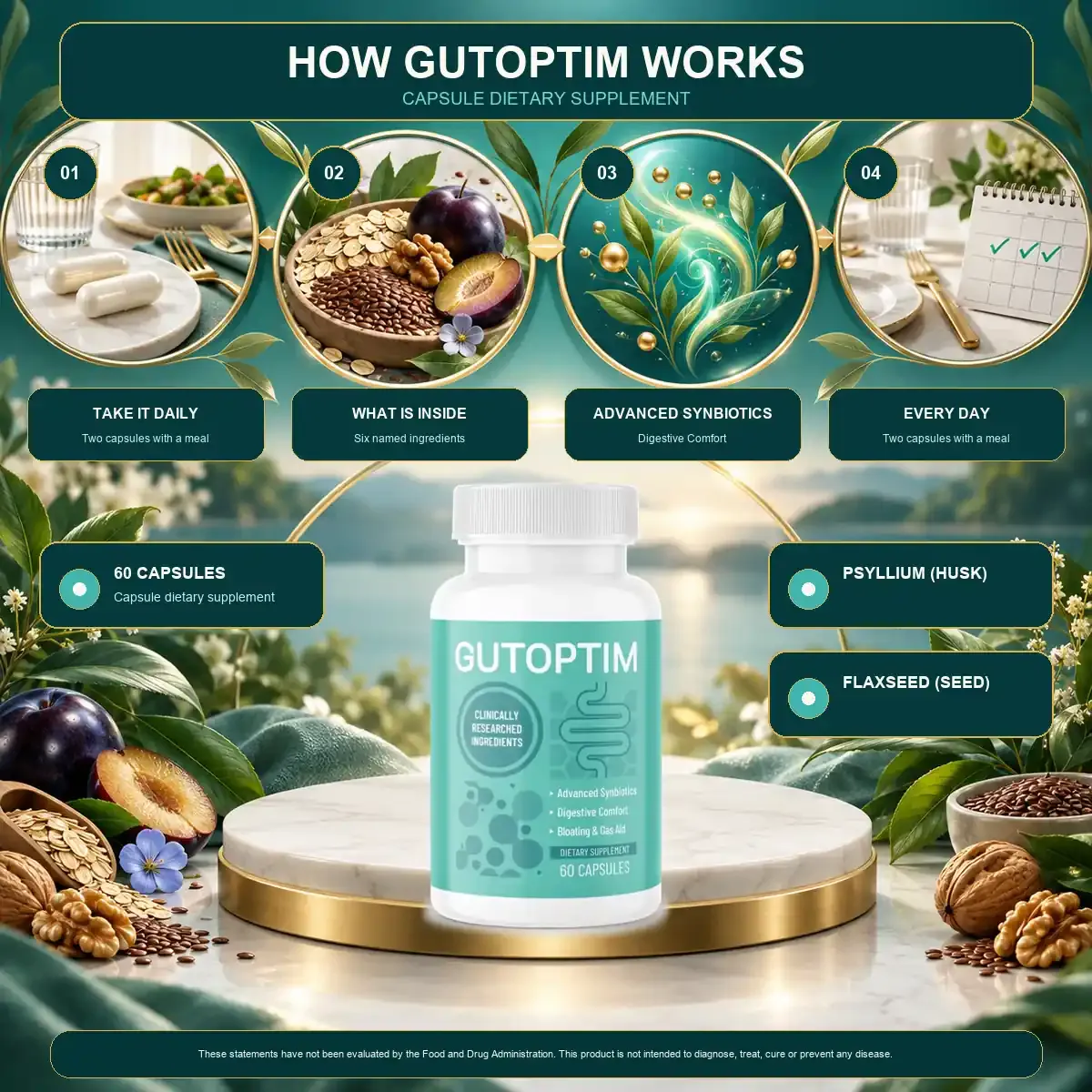
Two capsules a day with a meal and a full glass of water. From $49 a bottle with free US shipping, and a 60-day money-back guarantee while you settle in.

How long does the adjustment usually last?
There is no fixed timeline, and it differs from person to person. Fiber trials ran from 3 to 12 weeks, which gives a sense of the pace. Pushing faster usually means more gas, not faster results.
- First days
Some extra gas or fullness is common as bacteria meet new fiber.
- First weeks
Many people notice gas easing as meals and fiber stay steady.
- Several weeks in
A routine should feel settled. If gas is still rising, slow down or talk to your doctor.
Our results timeline lays out what buyers report over the first weeks, and why the 60-day refund window matters.
How can GutOptim users ease in?
GutOptim users can ease in by keeping everything else steady while the capsules become a habit. These steps follow the label and add a few comfort habits.
Pair it with a meal
The label says two capsules daily with a meal. Food in the stomach makes the routine easier on your gut.
Drink a full glass every time
At least a full glass of liquid, as the label directs. Skip the capsules if swallowing is hard for you.
Hold other fiber steady for a week
Do not add new beans, bran or fiber powders in the same week you start. Change one thing at a time.
Ask about a slower start
If your gut is sensitive, ask your doctor whether one capsule a day for a few days makes sense before the label's two.
Walk after meals
A short, easy walk helps gas move along.
Keep a short log
Note capsules, meals and symptoms for two weeks. Patterns are easier to spot on paper.
Full timing tips live on the how-to-use page.
Why does water matter for fiber comfort?
Water helps fiber do its job without adding strain. Gel fibers soak up fluid in the gut. If there is too little, stool can turn firm and slow, and that backup can feel like bloating.
Swelling fibers also need water for safety. U.S. rules require over-the-counter psyllium and glucomannan products to warn about choking and to call for a full 8 oz. glass of fluid (21 CFR 201.319). The GutOptim label asks for at least a full glass with the capsules.
Simple ways to drink more
Keep a glass or bottle within reach during meals. Add a glass at each meal on the days you add a new fiber food. Pale yellow urine is a handy sign you are getting enough.
Which everyday habits add extra gas?
Some everyday habits add gas on top of fiber. Cutting a few of them can make the early weeks easier.
Eating fast
Gulping food means swallowing air. Slow down and chew well.
Fizzy drinks
Carbonation puts gas straight into your stomach. Choose still water for a while.
Sugar-free gum and candy
Many use sorbitol or similar sugar alcohols, which are fermented like fiber.
Big, late meals
Large meals late in the evening leave more to digest at night.
When is bloating not from fiber?
Sometimes bloating has nothing to do with fiber. See a doctor if bloating comes with any of the signs below. These need a proper check, not a slower fiber plan.
- Blood in the stool, or black, tarry stools
- Weight loss you cannot explain
- Fever or repeated vomiting
- Severe or constant belly pain
- A belly that stays swollen and hard, with no gas or stool
- Trouble or pain when swallowing
Our digestive health guide has a fuller red-flag table.
What should you expect from GutOptim for bloating?
GutOptim lists "Bloating & Gas Aid" on its label, with the FDA disclaimer. That claim has not been tested on the product itself. The front badge, "Clinically Researched Ingredients," means the ingredients have been studied, not the capsule.
The blend holds fibers that ferment, plus plum. At 1.5 g for all ten ingredients, the amount of each is small, so strong gas from the capsules alone is less likely. The most common complaint in the retailer's review pack (not independently verified) is a slow start, not gas.
The blend also contains bentonite clay and aloe leaf. Read bentonite clay and aloe: what to know before you start, and see the side effects page for the full list.
Fiber and bloating FAQ
Is it normal to feel bloated when starting fiber?
Yes, mild gas and bloating are common when you add fiber quickly. Gut bacteria make gas as they ferment it. It often eases as your routine settles.
How long does fiber bloating last?
It varies from person to person. Many people find it settles as their gut adjusts, but there is no set timeline. If it keeps getting worse, talk to your doctor.
Which fibers cause the least gas?
Psyllium is mostly not fermented, so it tends to add less gas. Fermented fibers such as pectin, oat bran and glucomannan, and prunes, tend to add more.
Can GutOptim cause gas?
It can, mainly in the early days. Its blend includes fermented fibers and plum. At 1.5 g for the whole blend, any effect is usually mild.
Does drinking water reduce fiber bloating?
Water helps fiber move and soften stool, which can ease discomfort. The GutOptim label asks for at least a full glass of liquid with the capsules.
When is bloating a sign of something serious?
See a doctor for bloating with weight loss, blood in the stool, fever, vomiting, severe pain, or a belly that stays swollen and hard.
Should I stop GutOptim if I feel bloated?
Mild gas often eases on its own. Hold other new fiber steady, drink more water and give it a few days. Stop and call your doctor if pain grows or any red-flag sign appears.
Is it better to take GutOptim in the morning or at night?
The label only says with a meal. Many people choose breakfast or lunch, since swelling fibers are not advised right before bed.