
GutOptim Guides: Where to Start on Fiber, Digestion and Labels
Quick answerThe GutOptim library has 2 long guides and 3 blog articles, plus the product pages that explain the label. New to fiber? Start with the digestive health guide. Comparing products? Start with the buying guide. Every piece links its sources and states the dose that was studied, so you can compare it with the 1.5 g blend in two capsules.
What is in the GutOptim guide library?
This hub gathers every long read on the site in one place. Two guides cover the big picture, and three shorter articles each answer one question in depth.
The guides are written for adults in the US who want plain facts before they buy. Each one ties the research back to the GutOptim label, so you can see what a study tested and how that compares with two capsules a day.
Where the guides begin
Most adults eat far less fiber than advised. US adults average about 15-18 g a day (USDA WWEIA, 2017-2020), and more than 90% of women and 97% of men miss the goal of about 22-34 g (Thompson, 2021). The digestive health guide starts there, with food first.
Which long guides should you read?
Two in-depth guides. One explains digestion and fiber. The other shows how to compare digestive health supplements.
Digestive health guide
How digestion works, what soluble and insoluble fiber do, why most adults fall short on fiber, and which daily habits have the most support.
Read the digestive health guideChoosing a digestive health supplement
How to read a label: fiber grams, proprietary blends, probiotic CFU and strains, seals, cost per day and refund terms.
Read the buying guideWhich articles answer one question in depth?
Short reads from the GutOptim blog, each built around one common question.
Psyllium vs. other fibers
Psyllium, oat bran, pectin, flax and glucomannan side by side: what each does and the doses studies used.
Read the articleWhy fiber can cause bloating at first
Why fermentable fibers make gas early on, how long it tends to last and simple ways to ease in.
Read the articleBentonite clay and aloe: what to know
The two ingredients with the most cautions: clay and medicines, the lead question, and aloe leaf types.
Read the articleWhich reading path fits your goal?
| If you want to | Read first | Then read | Then check |
|---|---|---|---|
| Understand fiber from scratch | Digestive health guide | Psyllium vs. other fibers | Ingredients |
| Compare products before buying | Choosing a supplement | Supplement Facts | Pricing |
| Know what to expect in week one | Why fiber can cause bloating | How to use | Results timeline |
| Check safety with medicines | Bentonite clay and aloe | Side effects | Who it's for |
| Judge the evidence | Ingredients | Testing and quality | Reviews |
| Understand the refund before ordering | Guarantee | Refund policy | Shipping |
Which GutOptim product pages go with the guides?
The guides explain the science. These pages apply it to the bottle.
Ingredients
All ten blend ingredients in GutOptim, what each is and what research says.
See ingredientsSupplement Facts
The full label panel with notes on each line, from serving size to storage.
Read the labelHow it works
How gel-forming fiber, clay and a probiotic are meant to work together.
How it worksHow to use
Two capsules with a meal, the full glass of liquid, and a steady routine.
How to useSide effects
Gas early on, the choking notice, clay and medicines, and who should avoid it.
Side effectsResults timeline
What fiber trials measured and why buyers judge it over weeks, not days.
See the timelineWhy do the guides start with the label, not the pack art?
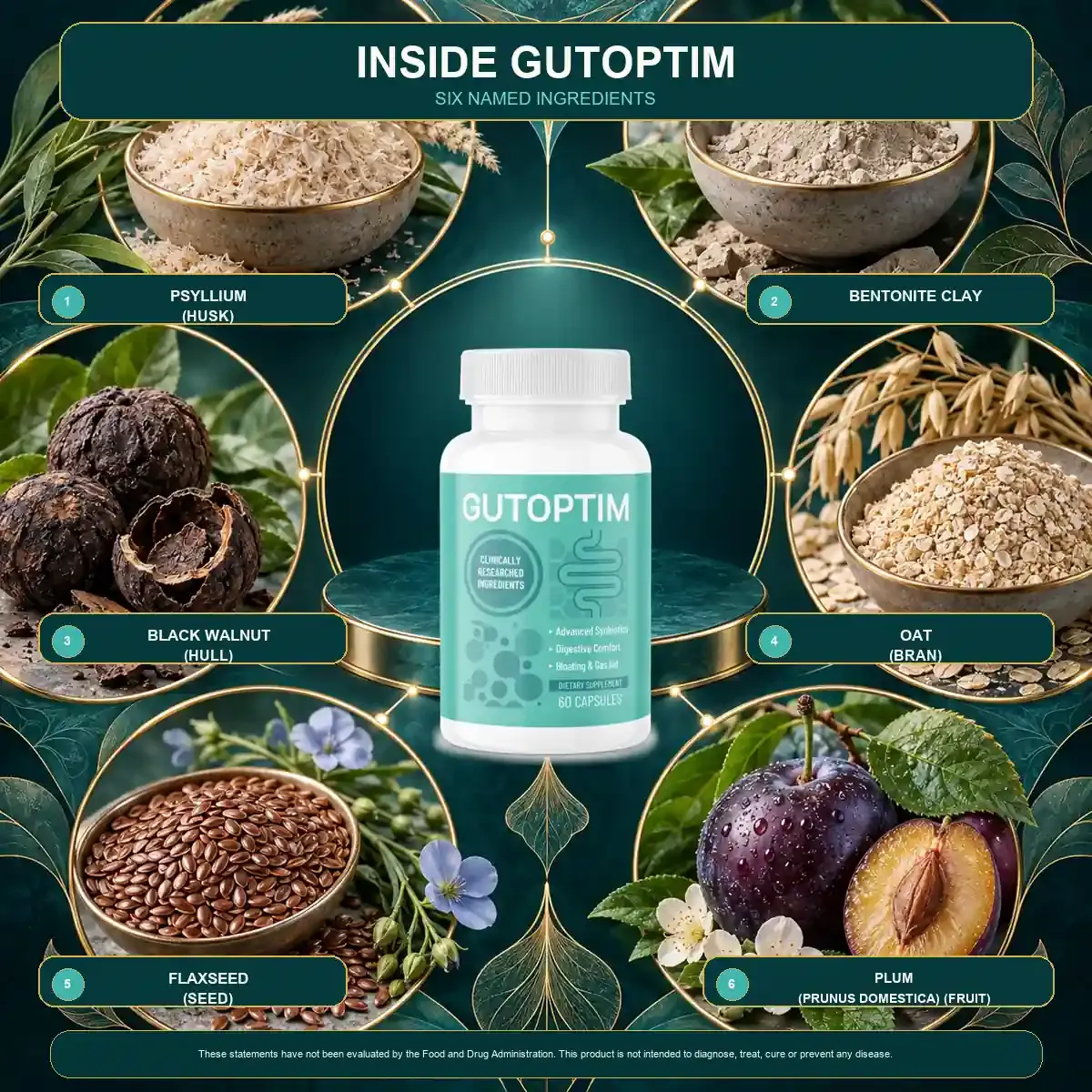
The guides work from the label, not the marketing art. The pack graphic names six ingredients around the bottle, while the Supplement Facts panel lists ten.
That gap is a good example of why the reading paths start with the label. The four extra ingredients include the two with the most cautions for daily use: glucomannan, which swells a lot, and aloe leaf. Both are covered in the clay and aloe article and on the side effects page.
When you finish a guide, open the Supplement Facts page next to it. Checking each claim against the printed panel takes only a few minutes.
How are the guides researched and written?
Start from the label
Every guide begins with what the GutOptim label actually prints: the 1.5 g blend, the ten ingredients and the warnings.
Link the source
Each research claim links to its study or agency page, such as (McRorie et al., 2021) for psyllium dosing or (ACG IBS guideline, 2021) for fiber and IBS.
State the tested dose
When a study used a set amount, we say it, so you can compare it with the blend instead of taking a claim on trust.
Say what is missing
If a fact is not published, such as a CFU count or single-ingredient amounts, we write “not published” rather than guess.
What do the common label terms mean?
| Term | What it means | Where it shows up in GutOptim |
|---|---|---|
| Soluble fiber | Fiber that dissolves in water and forms a gel. | Psyllium, oat bran, apple pectin, glucomannan, flaxseed |
| Proprietary blend | A single total weight for several ingredients, without each amount. | The 1.5 g GutOptim blend |
| Probiotic | Live microbes that help when taken in adequate amounts. | Lactobacillus acidophilus |
| Synbiotic | A product that pairs a prebiotic fiber with a probiotic. | “Advanced Synbiotics” on the label |
| CFU | Colony-forming units, the count of live bacteria. | Not published |
| Bulk-forming laxative | Fiber that adds water and bulk to stool. | Psyllium and glucomannan work this way |
| Aloin | The laxative compound in aloe leaf latex. | Not stated whether GutOptim's aloe is low-aloin |
| Choking warning | A required caution for fibers that swell. | Printed on the GutOptim label |
Which sources do the guides use most?
Six of the sources cited most often across the guides and articles.
- Lacy BE, et al. (2021). ACG Clinical Guideline: Management of Irritable Bowel Syndrome. American Journal of Gastroenterology 116:17-44. Suggests soluble, not insoluble, fiber for IBS, and warns fermented fibers can add gas and bloating.
- McRorie JW Jr, et al. (2021). Psyllium: The Gel-Forming Nonfermented Isolated Fiber That Delivers Multiple Fiber-Related Health Benefits. Nutrition Today 56(4):169-182. The therapeutic psyllium dose is about 10 g a day in divided doses, starting near 3.4 g; the lead author worked for a psyllium brand maker.
- Moayyedi P, et al. (2014). The effect of fiber supplementation on irritable bowel syndrome: a systematic review and meta-analysis. American Journal of Gastroenterology 109(9):1367-74. In 14 trials with 906 patients, psyllium improved IBS symptoms (1 in 7 helped); bran did not.
- U.S. Code of Federal Regulations (2026). Water-soluble gums, hydrophilic gums, and hydrophilic mucilloids: required warning. ecfr.gov. Over-the-counter products with glucomannan or psyllium must warn about choking and require a full glass (8 oz.) of fluid.
- NIH National Center for Complementary and Integrative Health (2025). Aloe Vera: Usefulness and Safety. nccih.nih.gov. There is not enough reliable evidence that oral aloe helps IBS, and oral aloe leaf extracts have been linked to cases of hepatitis.
- NIH Office of Dietary Supplements (2025). Probiotics: Health Professional Fact Sheet. ods.od.nih.gov. Probiotic recommendations need to be strain-specific; many products have 1-10 billion CFU per dose.
Why a seller writes these guides
These guides are written by a seller, and that shapes how we handle them. We earn money when you buy GutOptim through this site, so we keep the research and the product apart.
Where the studies used far more of an ingredient than GutOptim contains, the guides say so plainly. Where a seal on the pack does not match the label, they point it out. The about page explains who we are and how we check facts.
GutOptim guides FAQ
Which GutOptim guide should I read first?
Read the digestive health guide first if fiber and probiotics are new to you. If you already know the basics and want to compare labels, start with the guide to choosing a digestive health supplement.
Are the GutOptim guides free?
Yes. Every guide and article on this site is free to read, with no sign-up and no email needed.
Who writes the GutOptim guides?
The GutOptim Editorial Desk at Mygutoptim writes and checks them. We are the U.S. stocking partner for GutOptim, not the maker, and we earn money when you buy through this site.
Do the guides give medical advice?
No. They explain ingredients and research in plain English. For a health question, talk to your doctor or pharmacist.
Are these guides the same as the bonus e-books?
No. The two bonus e-books come with the 3-bottle and 6-bottle packs and are written by the publisher. The guides on this page are separate and free for everyone.
How often are the guides updated?
We update a guide when the label, a price or a cited source changes. The date at the top of each page moves forward when we do.
Done reading? Try GutOptim for yourself
Put what you read to the test with two capsules at a meal each day. Packs start at $49 a bottle, ship free in the US, and come with 60 days to decide.